How to Fall Asleep Fast: A Calm Plan for Tonight
When sleep will not come, trying harder usually adds pressure. Use this page to reduce what is keeping you alert, choose one calming response, and decide whether tonight is a one-off or part of a pattern that deserves more help.

The short answer
Go to bed when you feel sleepy, not only because the clock says it is late. Keep the final part of the evening low-stimulation. If you become wide awake or frustrated in bed, stop forcing it: move to a safe, dim place for a quiet activity and return when sleepiness comes back. Relaxation can support this plan, but no breathing count, visualisation, or viral method can promise sleep in a fixed number of minutes.
There is no single reason a tired person stays awake. You may be physically tense, mentally busy, not yet sleepy at your current bedtime, uncomfortable in the room, or dealing with a symptom that a bedtime routine cannot solve. That difference matters more than collecting ten new sleep tricks.
This guide separates what may help tonight from what to do when the problem keeps returning. Start with the box that sounds most like you, then follow the shared plan below.
Start here: what is keeping you awake?
My mind is busy
You are replaying conversations, planning tomorrow, worrying, or checking whether sleep is happening.
Use a mental off-rampMy body feels tense
Your jaw, shoulders, hands, stomach, or legs still feel braced even though you are tired.
Use gentle muscle releaseI am not sleepy yet
You went to bed at the planned time, but your eyes are open and your attention still feels sharp.
Protect the bed-sleep linkSomething feels wrong
Heat, noise, pain, reflux, breathing, leg urges, medicines, or another symptom may be interrupting sleep.
Check the help signsA four-stage plan for tonight
The steps work as a sequence. They are not four separate hacks to stack at once.
Lower the volume
Dim what you can, finish urgent tasks, and choose one quiet activity rather than switching between many.
Move into bed
Notice heavy eyes, repeated yawning, or drifting attention. Sleepiness is a more useful cue than the clock.
Pause the struggle
Leave the bed when safe, keep light dim, do something quiet, and return only when sleepy again.
Keep an anchor
Return to your usual wake time as closely as practical and observe the pattern without grading the night.
1. Before bed: make the next hour quieter
You do not need a perfect ritual. You need a clear change from daytime activity to a lower-stimulation evening. Put unfinished tasks on paper, reduce avoidable alerts, and choose an activity that is calm enough to stop naturally: a familiar book, gentle music, prayer, simple stretching, or preparing clothes for morning.
Screens are not an all-or-nothing test of discipline. Brightness, emotional content, work, games, and endless scrolling can all keep attention active. If you use a device, lower the brightness, avoid upsetting or urgent material, and give the activity a stopping point.
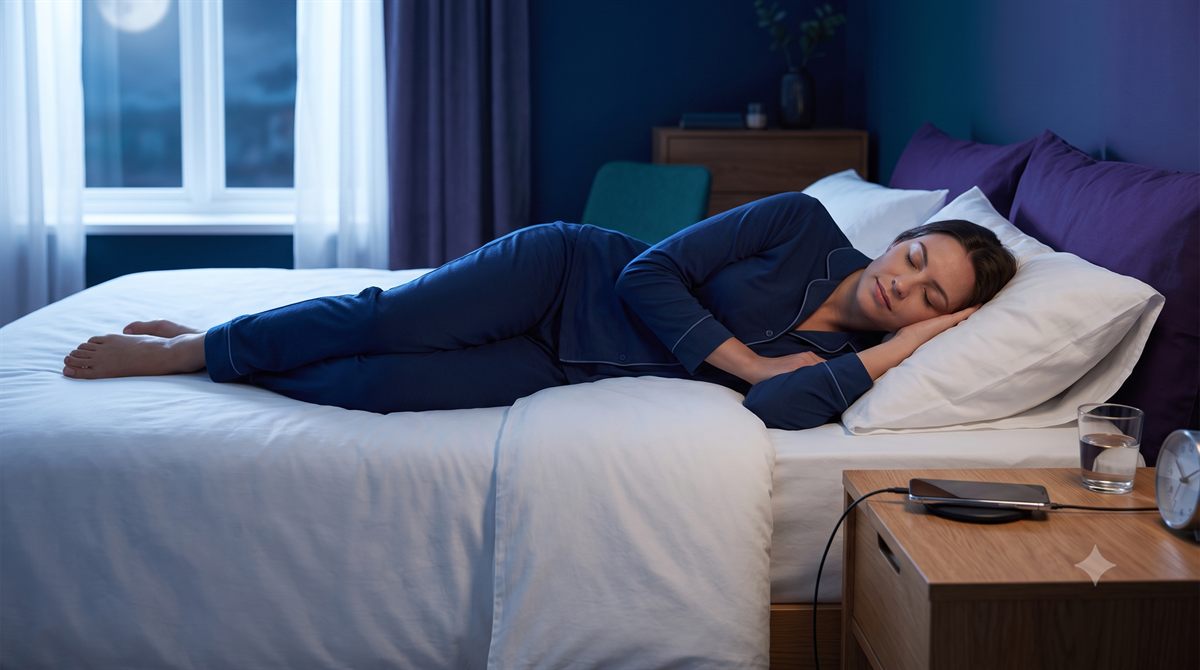
If caffeine may be part of the problem, do not guess from a universal cutoff. Dose, timing, medicines, and personal sensitivity differ. Use the Caffeine Cutoff Calculator as a planning estimate, then compare it with your own nights. If the room itself is the issue, the Bedroom Audit helps you check one category at a time.
2. At bedtime: wait for sleepiness, then stop monitoring
Feeling worn out is not always the same as feeling sleepy. Fatigue can feel like low energy while the mind remains alert. Sleepiness looks more like heavy eyelids, yawning, losing your place while reading, or thoughts becoming less organised. If you are clearly not sleepy, another quiet stretch outside bed may be more useful than lying down early and waiting.
Once in bed, turn the clock face away. Checking the time creates a new problem to solve: how little time is left, how tomorrow will go, and whether the method is working. Your job is to rest quietly, not to observe the exact moment consciousness changes.
Choose one calming method, not a stack
Relaxation is most useful when arousal is part of the barrier. Pick the option that feels easy enough to repeat. If it becomes a performance test, stop counting and make it gentler.
A two-minute pressure release
Say to yourself: “I do not have to make sleep happen right now.” Unclench your jaw, drop your shoulders, and take five easy breaths. Then place attention on one neutral sensation, such as the weight of the blanket. If your mind wanders, return without restarting or judging the exercise.
Still awake? Protect the bed-sleep connection
When wakefulness turns into frustration, the bed can start to feel like a place for effort, planning, and clock-watching. Stimulus control, one component used in cognitive behavioural therapy for insomnia (CBT-I), aims to rebuild a clearer link between bed and sleep.
- If you feel you have been awake for roughly 15 to 20 minutes, or you notice frustration rising, get out of bed when it is safe. Do not watch the clock to measure the interval precisely.
- Use low light and choose a quiet, non-urgent activity. Avoid work, arguments, upsetting news, shopping, or anything that is difficult to stop.
- Return to bed when your eyes feel heavy or your attention begins to drift.
- Repeat if needed. The purpose is not to punish wakefulness; it is to stop rehearsing a long struggle in bed.
If leaving bed would be unsafe because of falls risk, mobility limits, dizziness, caregiving duties, or the physical layout, adapt the idea: sit up, move to the edge of the bed, or use a calm activity in the safest available position. A clinician can help tailor the full method.
Popular “fall asleep fast” methods, put in perspective
Several techniques can be pleasant relaxation cues. The problem begins when a useful cue is sold as a guaranteed biological shortcut.
| Popular idea | What may be useful | What not to assume |
|---|---|---|
| 4-7-8 breathing | A fixed count can hold attention and slow the pace of breathing. | The exact numbers are not a proven sleep switch. Shorten or skip the breath hold if uncomfortable. |
| Military sleep method | Muscle release and calm imagery overlap with familiar relaxation ideas. | The widely repeated “sleep in two minutes” outcome is not a dependable promise. |
| Cognitive shuffle | Neutral, unrelated images may interrupt planning or repetitive worry for some people. | It has a smaller evidence base than multicomponent CBT-I and will not fit every busy mind. |
| 90-minute sleep-cycle bedtime | Working backward can remind you to leave enough sleep opportunity. | Human sleep cycles vary, so a calculated clock time cannot guarantee faster sleep or easier waking. |
Animal-style chronotype labels can be memorable planning language, but they are not diagnoses or fixed biological identities. If your sleep time has drifted later or earlier, use the practical guidance in How to Fix Your Sleep Schedule instead of forcing an early bedtime tonight.
If this keeps happening, run a seven-night check
A single night is noisy data. For one week, change only one manageable factor and record a few observations. This is not a diagnostic diary; it is a way to see whether the same barrier repeats.
Your one-variable experiment
Choose one change: a steadier wake time, earlier caffeine cutoff, a dimmer final hour, or leaving bed when frustration rises. Keep the rest of your routine as ordinary as practical.
Do not deliberately reduce your time in bed based only on this article. Formal sleep efficiency training or sleep restriction is a structured part of CBT-I that may temporarily increase sleepiness and needs individual safety considerations. Discuss it with a trained professional, especially if you drive for work, operate machinery, have a seizure disorder, bipolar disorder, or significant daytime sleepiness.
When a bedtime guide is not enough
Talk with a qualified healthcare professional when difficulty falling asleep keeps returning, causes distress, or affects concentration, mood, work, study, relationships, or driving. Ask specifically about CBT-I when long-term insomnia is a concern; major clinical guidance recommends it as a first treatment for chronic insomnia.
- Seek assessment for loud habitual snoring, witnessed breathing pauses, choking or gasping in sleep.
- Mention strong urges to move the legs, significant pain, reflux, hot flashes, or medicines and substances that may be affecting sleep.
- Do not drive or operate machinery when dangerously sleepy. Use a safer transport or rest plan.
- Seek urgent local help for chest pain, severe breathing difficulty, or thoughts of self-harm. This page is not an emergency service.
Why this page prioritises behaviour over “sleep hacks”
The American Academy of Sleep Medicine recommends multicomponent CBT-I for chronic insomnia and gives conditional support to stimulus control and relaxation as individual treatments. It also advises against using sleep hygiene alone as the treatment for chronic insomnia. That is why room and routine tips appear here as supporting steps, while repeated trouble points toward proper assessment and CBT-I.
Not sure which sleep concern fits?
Use the Sleep Problem Finder to organise what you notice into a plain-language route. It does not diagnose a condition; it helps you choose the most relevant page and recognise when professional help is the better path.
Open Sleep Problem Finder →Common questions
What should I do if I cannot fall asleep?
Avoid forcing sleep and stop checking the time. If you feel wide awake or frustrated, leave the bed when it is safe, keep the light dim, and do something quiet until sleepiness returns.
How long should it take to fall asleep?
There is no single minute target that diagnoses a problem. An occasional slow night is common. The more useful signals are a repeated pattern, distress about sleep, and effects on daytime life.
Does 4-7-8 breathing make you sleep quickly?
It may be a relaxing attention cue, but it is not a guaranteed sleep switch. Use a comfortable pace and avoid a long breath hold if it causes dizziness, air hunger, or anxiety.
Is the military sleep method proven to work in two minutes?
No dependable two-minute result should be promised. Its muscle-release and imagery elements may feel calming, so it can be treated as an optional relaxation routine rather than a performance target.
Why am I tired but still unable to sleep?
Fatigue and sleepiness are not identical. Stress, timing, caffeine, evening stimulation, discomfort, pain, breathing problems, leg symptoms, medicines, and other factors can leave a tired person alert. A repeated pattern deserves assessment rather than more bedtime tricks.
Sources and evidence notes
- American Academy of Sleep Medicine clinical practice guideline: behavioural and psychological treatments for chronic insomnia (2021).
- National Heart, Lung, and Blood Institute: Insomnia treatment and CBT-I.
- VA/DoD Clinical Practice Guideline for chronic insomnia disorder and obstructive sleep apnoea (2025).
- Centers for Disease Control and Prevention: About Sleep.
Evidence boundary: This article combines established behavioural principles with low-risk self-observation. It does not provide a CBT-I programme, diagnose insomnia, or recommend a medicine or supplement. Sources were reviewed on 1 September 2026.