Sleep Cycles Explained: What the Four Stages Really Mean
Your night is not a row of identical 90-minute blocks. It is a changing pattern of N1, N2, N3 and REM sleep, with normal differences from one cycle and one night to the next.

Four stages repeat, but they do not repeat like clockwork
N1, N2 and N3 are non-REM sleep; REM is a separate stage. A cycle usually starts over after roughly 80 to 100 minutes, and many people have about four to six cycles in a night. Deep N3 sleep is usually stronger earlier, while REM periods usually grow later. These are broad patterns, not a personal timetable.
A whole night changes from beginning to end
You normally move down through non-REM sleep and later return toward lighter sleep or REM. Brief awakenings can occur between cycles, and you may not remember them. The important point is not to count perfect loops. It is to see how the balance changes: N3 is generally more prominent earlier, while REM is generally more prominent later.
One representative night
Illustration only. It is not a measured sleep study and does not assign exact minutes.
How to read it: move from left to right through the night. A coloured horizontal bar marks an illustrative period in that stage; a wider bar means a longer period in this example, not an exact number of minutes.
Age, sleep loss, the time you sleep, alcohol, medicines, illness and sleep disorders can all alter this architecture. Even in the same person, a single unusual night is not enough to define a stable pattern.
The four stages, without the technical fog
Stage names describe patterns that trained professionals see in recorded signals. They are useful labels, but they are not four separate jobs with one benefit assigned to each box. Memory, learning, body regulation and recovery involve overlapping processes across sleep.
N1: the transition into sleep
This is the light transition from wakefulness. Awareness of the room fades, and you may still feel as if you were awake if someone wakes you quickly.
Do not overread it: a brief N1 estimate on a tracker is not proof of a problem.
N2: settled non-REM sleep
You are clearly asleep. Brain activity shows characteristic features called sleep spindles and K-complexes, while heart rate and breathing generally become steadier.
Do not dismiss it: “lighter” does not mean useless or poor-quality sleep.
N3: deep, slow-wave sleep
This is the deepest non-REM stage and can be harder to wake from. It is usually more prominent in the earlier part of a normal night.
Do not turn it into a target score: expected amounts change with age and circumstances, and a wearable only estimates the stage.
REM: active-brain sleep
Rapid eye movements appear, vivid dreams are common, and most limb muscles are temporarily relaxed. REM periods usually become longer later in the night.
Do not make REM the only dream stage: dreaming can also occur outside REM.
What the popular 90-minute rule gets right and wrong
Ninety minutes is memorable because it sits near the middle of the broad 80-to-100-minute range described by NHLBI. It can be used for simple clock planning. The mistake is treating that average as a sensor inside your body.
What it can do
Generate a few possible bedtimes or wake times, then help you notice whether the plan leaves enough sleep opportunity for real life.
What it cannot do
Know when you actually fell asleep, detect your current stage, predict awakenings, or promise that one option will make you feel refreshed.
A cycle can also differ from the previous cycle in the same night. Counting “five perfect cycles” may look precise, but the precision comes from arithmetic, not from measuring your sleep.
A sleep study, wearable and calculator answer different questions
The words “sleep data” can hide three very different methods. Before trusting a result, ask what was actually measured.
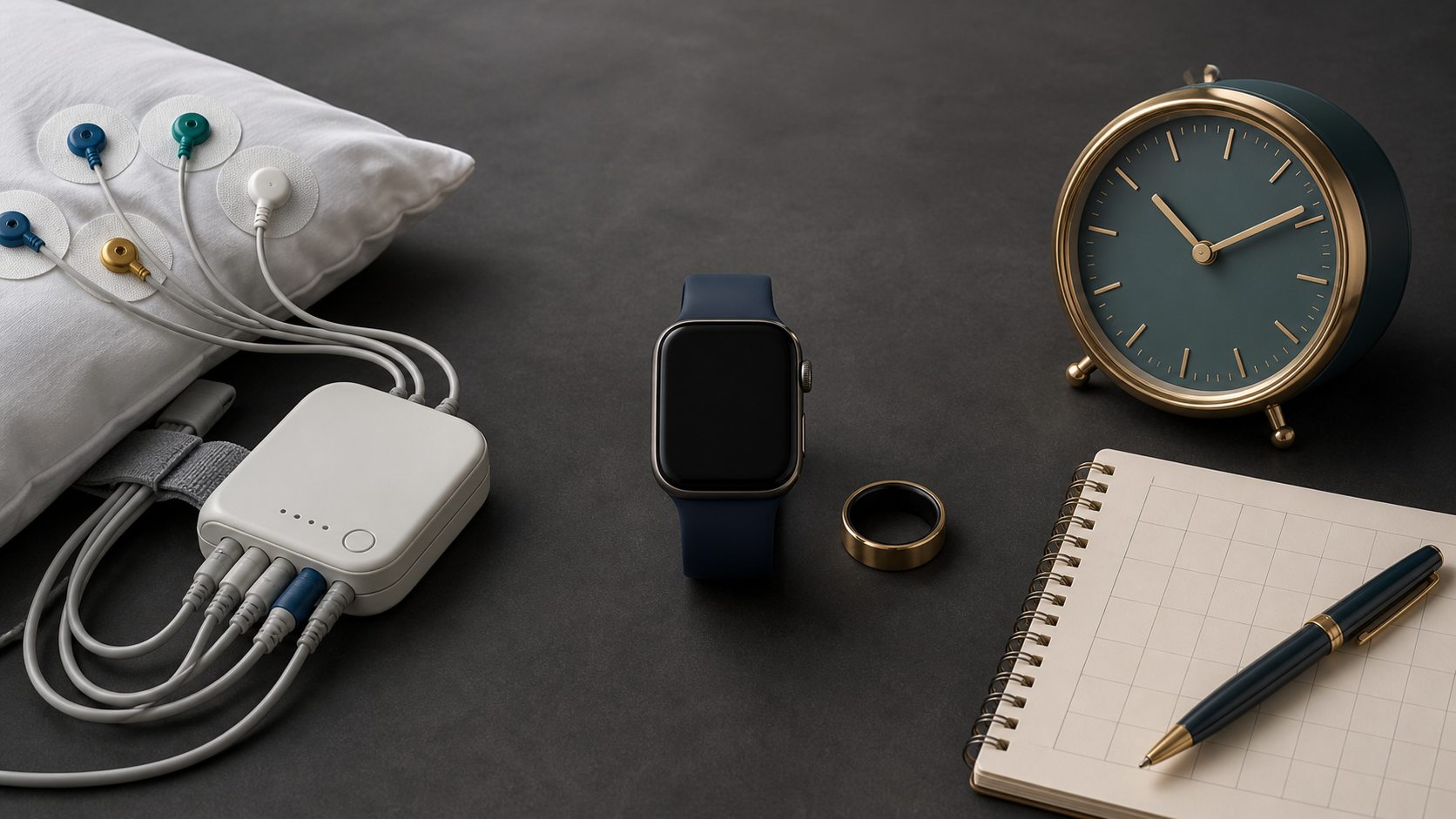
Clinical sleep study
Polysomnography records brain waves, eye movements and muscle activity along with breathing, heart rate and oxygen information. Qualified staff interpret the combined signals.
Can measure and clinically assessConsumer wearable
A watch or ring commonly uses movement and optical pulse signals, then an algorithm estimates sleep and stages. Results can differ between devices and from a sleep study.
Can estimate trendsClock calculator
A calculator adds or subtracts assumed cycle blocks and any fall-asleep time you enter. It receives no signal from your brain or body.
Can plan times onlyTreat stage graphs as estimates, then look for useful patterns
A colourful graph can feel more certain than it is. Consumer devices may be reasonably useful for broad sleep-wake patterns, but stage classification remains less reliable than simply detecting sleep. The most useful question is usually not “Did I get the perfect REM percentage?” but “Is there a repeated pattern that matches how I feel and what happened?”
- Compare several ordinary nights. One late meal, illness, travel day, loose sensor or unusual bedtime can distort a single result.
- Start with timing and continuity. Bedtime, wake time, long awakenings and total sleep estimates are easier to relate to your routine than an exact stage percentage.
- Add your daytime experience. Record sleepiness, concentration and safety. A high device score does not cancel persistent symptoms.
- Do not self-diagnose from a stage graph. A wearable cannot confirm sleep apnoea, insomnia, narcolepsy or another sleep disorder.
- Take repeated concerns to a professional. Bring the trend as background information, not as a completed diagnosis.
Why this boundary matters
The American Academy of Sleep Medicine says consumer sleep technology should not be used to diagnose or treat sleep disorders without clinical evaluation. A 2025 laboratory comparison of six wrist devices also found device-specific differences and only fair-to-moderate agreement for multi-stage classification. That does not make every wearable useless; it tells us to use the output for cautious trend awareness.
A “cycle endpoint” cannot guarantee a clear-headed wake-up
The temporary fog after waking is called sleep inertia. The stage you wake from may matter, but it is not the whole explanation. Prior sleep loss, waking during your biological night, nap length, individual differences and the time since your eyes opened can also affect alertness.
For an ordinary morning
Leave enough sleep opportunity, use a consistent wake time where practical, get ordinary daylight, and allow a short transition before making important decisions.
For safety-critical tasks
Do not rely on a smart alarm or cycle estimate before driving, operating machinery or responding on call. Use workplace fatigue controls and a safer transport or rest plan when sleepy.
If severe confusion after waking is frequent, prolonged or dangerous, it deserves individual assessment rather than tighter cycle arithmetic.
A sleep calculator plans clock options, not sleep stages
Sleep Manager uses a fixed cycle assumption and the fall-asleep time you enter to generate possible times. Compare the longer sleep opportunities first. Then check whether the option fits work, caregiving, medicines, travel and how much sleep you personally need. It cannot know your actual cycle length or wake stage.
When to look beyond sleep-stage explanations
Talk with a qualified healthcare professional when a sleep or daytime problem persists, affects daily life, or creates safety risk. A cycle diagram cannot identify the cause.
- Dangerous daytime sleepiness, dozing while driving, or repeated near-misses.
- Loud snoring, gasping, choking or witnessed breathing pauses.
- Acting out dreams, injuries during sleep, unusual movements or repeated severe confusion after waking.
- Ongoing difficulty falling asleep, staying asleep or waking refreshed despite enough sleep opportunity.
- A large change after starting a medicine, using alcohol or another substance, or developing a health concern.
Sleep-cycle questions, answered plainly
What are the four stages of sleep?
The four stages are N1, N2, N3 and REM. N1, N2 and N3 are non-REM stages. A night normally moves through these stages repeatedly, but the order and time spent in each stage are not identical in every cycle.
Is every sleep cycle exactly 90 minutes?
No. The National Heart, Lung, and Blood Institute says a cycle usually starts over every 80 to 100 minutes. Ninety minutes is a convenient planning estimate, not a personal measurement or promise.
Can a smartwatch accurately measure my sleep stages?
A consumer wearable estimates stages from signals such as movement and heart rate. It does not measure the same combination of brain, eye, muscle, breathing and oxygen signals used in an overnight sleep study. Use stage graphs as trend estimates, not as a diagnosis.
Does waking at the end of a cycle prevent grogginess?
No wake time can guarantee that. Grogginess after waking, called sleep inertia, can be affected by sleep loss, body-clock timing, the waking transition and other factors. A clock calculator cannot see your real sleep stage.
Why do sleep stages look different later in the night?
N3 deep sleep is usually more prominent earlier in the night, while REM periods usually become longer later. Age, sleep timing, sleep loss, medicines, alcohol, health and normal night-to-night variation can also change the pattern.
Sources and review notes
- National Heart, Lung, and Blood Institute: Stages of Sleep.
- National Heart, Lung, and Blood Institute: Sleep Studies.
- American Academy of Sleep Medicine: Consumer Sleep Technology position statement.
- Schyvens and colleagues, 2025: six consumer wrist-worn devices compared with polysomnography.
- Hilditch and McHill, 2019: Sleep inertia, current insights.
Evidence boundary: This article explains established stage patterns, areas of normal variation and measurement limits. It does not interpret an individual sleep study, prescribe a target stage percentage, diagnose a disorder or promise a wake time. Sources were reviewed on 26 August 2026.